Debt avalanche vs debt snowball: which payoff method saves more?
A worked example with four real-world debts shows how much each method costs, how long it takes and how to pick the one you will actually stick with.
Some links are affiliate links: we may earn a commission at no cost to you. How we make money.
If you have more than one debt, the order you pay them off changes how much interest you pay and how quickly you see progress. The two best-known methods are the debt avalanche (highest interest rate first) and the debt snowball (smallest balance first). Both beat paying only the minimums by a wide margin. This guide runs the numbers on a realistic example so you can see the trade-off clearly.
How both methods work
Both methods start the same way:
- List every debt with its balance, interest rate (APR) and minimum payment.
- Decide on one fixed monthly amount for debt repayment, above the total of your minimums.
- Pay the minimum on every debt, every month.
- Put all the extra money on one target debt.
- When the target is paid off, roll its whole payment onto the next target.
The only difference is how you choose the target:
| Method | Target debt | Main advantage |
|---|---|---|
| Avalanche | Highest interest rate | Lowest total interest, mathematically optimal |
| Snowball | Smallest balance | Quick wins that keep you motivated |
A worked example: $17,200 across four debts
Here is a typical mix of debts:
| Debt | Balance | APR | Minimum payment |
|---|---|---|---|
| Store card | $1,200 | 26.9% | $40 |
| Credit card | $5,000 | 22.9% | $150 |
| Personal loan | $3,000 | 11.0% | $100 |
| Car loan | $8,000 | 7.5% | $250 |
| Total | $17,200 | $540 |
The minimums add up to $540 a month. Suppose you can commit $800 a month, so $260 extra goes to the target debt. We simulated every month for each approach:
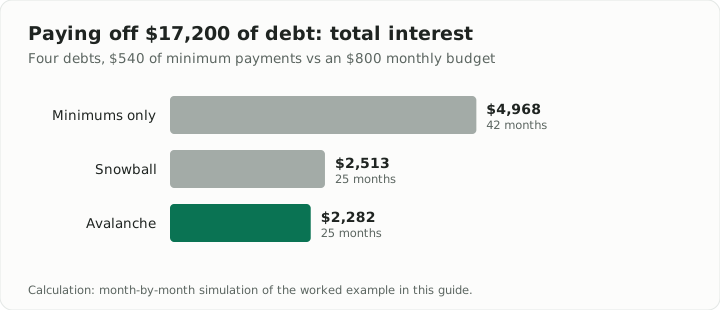
| Approach | Debt-free in | Total interest |
|---|---|---|
| Minimum payments only ($540/month) | 42 months | $4,968 |
| Snowball ($800/month) | 25 months | $2,513 |
| Avalanche ($800/month) | 25 months | $2,282 |
Three things stand out:
- The extra $260 a month is what matters most. Either method roughly halves the interest and cuts 17 months off the timeline compared with paying minimums.
- The avalanche saves $231 here. That is real money, but it is a small difference next to the $2,500 or so saved by paying more each month.
- The snowball gets you an early win. In this example both methods clear the store card first (it is both the smallest balance and the highest rate). After that, the snowball clears the personal loan in month 12, while the avalanche finishes the credit card in month 17 and the personal loan in month 20.
When the avalanche wins clearly
The gap between the two methods grows when:
- Your largest debt also has the highest rate, such as a big credit card balance at 25% or more.
- The rates are very different from each other, for example 28% on one card and 5% on a student loan.
- You have a large extra payment to put to work each month.
In those cases, sending extra money to a small low-rate debt first can cost hundreds or even thousands of dollars more.
When the snowball is the better choice
Research on consumer debt repayment suggests that people who close individual accounts are more likely to keep going. If you have tried and abandoned debt plans before, the cost of quitting is far larger than the few hundred dollars the avalanche might save. The snowball is a reasonable choice when:
- Your interest rates are fairly similar.
- You have several small balances you can clear within a few months.
- Motivation, not maths, is what has stopped you before.
Tip: You can combine the two. Clear any tiny balance under a few hundred dollars first for a quick win, then switch to the avalanche for everything else.
Ways to speed up either method
- Lower the rate on your biggest debts. A 0% balance transfer card or a debt consolidation loan can cut the interest you pay while you work through the list.
- Find the extra money in your budget. A clear split such as the 50/30/20 budget shows where an extra $100–200 a month could come from.
- Send windfalls to the target debt. Tax refunds, bonuses and side income go straight to the current target.
- Keep a small cash buffer. Without even a starter emergency fund, one surprise bill sends you back to the credit card.
- Stop adding new debt. Use cash or debit for everyday spending while you pay down cards.
How to set it up in an afternoon
- Collect your latest statements and write down each balance, APR and minimum.
- Pick your monthly debt budget and set it as an automatic payment where you can.
- Choose avalanche (sort by APR) or snowball (sort by balance).
- Set reminders to update the list once a month and roll payments forward as each debt is cleared.
Our loan calculator shows how much of each payment goes to interest, which is a useful reality check for your highest-rate debt.
The bottom line
The avalanche always costs the least on paper. The snowball often keeps people going. In most real situations, the difference between them is much smaller than the difference between either method and paying only the minimums. Pick the one you will stick with, pay a fixed amount every month and roll each freed-up payment into the next debt.
This guide is general information, not financial advice. If you are struggling to make minimum payments, a non-profit credit counselling service can help you review your options.
Loan & mortgage payment
More on Credit & Loans
Balance transfer cards: how 0% APR offers really work
How much a 0% balance transfer can save, how the transfer fee changes the maths, and the traps that can wipe out the benefit.
How to compare loan offers: APR, term and the true cost
A lower monthly payment can cost thousands more. How to read a loan offer, spot fee traps and pick the cheapest option.
How to raise your credit score: what works in 30, 60 and 90 days
The five factors behind your score, which ones you can move this month, and a 90-day plan that avoids common myths.
Is a debt consolidation loan worth it? How to run the numbers
How a consolidation loan replaces several high-rate debts with one fixed payment, a worked example with fees included, and when it is the wrong move.