How to raise your credit score: what works in 30, 60 and 90 days
The five factors behind your score, which ones you can move this month, and a 90-day plan that avoids common myths.
Some links are affiliate links: we may earn a commission at no cost to you. How we make money.
A better credit score means lower interest on loans, easier approvals and sometimes cheaper insurance. Some improvements take years, but a few can show up within a month. This guide explains what drives your score, then gives a realistic 30, 60 and 90-day plan.
Credit scoring differs by country. The figures below use FICO, the most widely used model in the United States, because it publishes how its score is weighted. The principles of paying on time and keeping debt low apply almost everywhere.
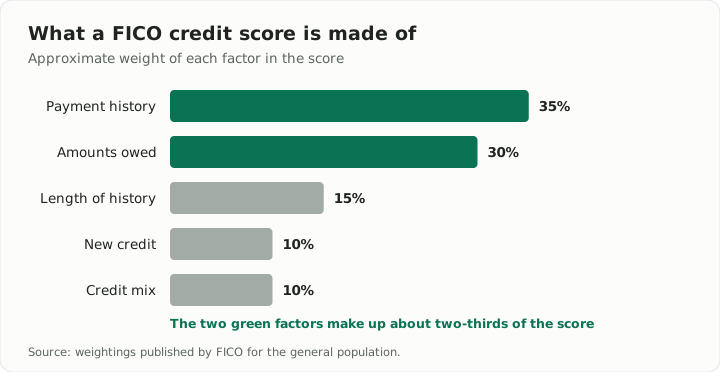
What your score is made of
| Factor | Approximate weight | What it measures |
|---|---|---|
| Payment history | 35% | Whether you pay on time |
| Amounts owed | 30% | How much of your available credit you use |
| Length of credit history | 15% | Age of your oldest and average accounts |
| New credit | 10% | Recent applications and new accounts |
| Credit mix | 10% | Variety of account types |
The first two factors make up about two-thirds of the score. Focus there first.
The fastest lever: credit utilisation
Utilisation is your card balances divided by your total card limits. Using $3,000 of a $10,000 limit is 30%.
- Lower is better. Keeping utilisation under 30% is a common guideline, and people with the highest scores often stay under 10%.
- It is calculated per card and across all cards, so one maxed-out card can hurt even when your total is low.
- It has no memory in most scoring models. Pay balances down and your score can recover as soon as the new balances are reported.
Pay before the statement date, not just the due date
Card issuers usually report your balance to credit bureaus around your statement closing date, not the payment due date. If you spend $2,000 during the month and pay it in full on the due date, the bureau may still see $2,000.
To report a low balance, pay most of it a few days before the statement closes. You still pay no interest, and the reported utilisation drops.
Payment history: protect it above everything
A single late payment can cost more points than any other mistake, and it stays on a US credit report for up to seven years. Its impact fades over time, but it is far easier to prevent than to repair.
- Set every account to autopay the minimum as a safety net, then pay the rest manually.
- In the US, a payment usually is not reported late until it is 30 days past due. If you miss a due date by a few days, pay immediately; you may avoid a reported late payment, though you can still owe a fee.
- If you already have a late payment on an otherwise clean record, it can be worth asking the lender for a goodwill adjustment. They are not obliged to agree.
What not to do
- Do not close your oldest card. It shortens your history and removes available credit, which raises utilisation. If it has an annual fee, ask about switching to a no-fee version instead.
- Do not open several cards at once. Each application usually triggers a hard inquiry. Inquiries have a small effect that fades within a year, but many at once can signal risk.
- Do not borrow to “build credit”. Taking a loan you do not need just to improve your mix rarely helps enough to justify the interest.
- Do not pay for “credit repair” that promises to remove accurate information. Accurate negative items cannot legally be removed early; only errors can.
Check your reports for errors
Mistakes on credit reports are common: accounts that are not yours, wrong balances, or late payments you did not make. In the US you can get free reports from all three bureaus at AnnualCreditReport.com, the official site. Other countries have their own free access rights.
If you find an error, file a dispute directly with the bureau and the lender, include evidence, and keep copies. Fixing a wrong late payment can raise a score noticeably.
Your 30, 60 and 90-day plan
Days 1–30
- Download your credit reports and dispute any errors.
- Set up autopay for at least the minimum on every account.
- Pay card balances down before each statement closing date.
- If you are close to a limit on one card, spread or reduce that balance first.
Days 31–60
- Watch your score update as lower balances are reported.
- Ask for a credit limit increase on a card you have held for a while, if the issuer can do it without a hard inquiry. A higher limit with the same spending lowers utilisation.
- Keep new applications to zero unless you truly need the account.
Days 61–90
- Keep utilisation low every month; this is where steady gains come from.
- If you have a thin file, consider becoming an authorised user on a trusted family member’s long-standing card with a perfect payment record and low balance.
- If you cannot get approved for a regular card, a secured card, backed by a deposit, builds history when you use it lightly and pay in full.
How long recovery takes
- High utilisation: can improve within one or two billing cycles of paying down.
- Hard inquiries: small effect, usually fading over a year.
- Late payments and collections: improve gradually as they age, with the strongest effect in the first two years.
- Thin credit history: grows only with time, which is why opening a first account early helps.
Tip: Check your score once a month, not daily. Scores move as lenders report, and small day-to-day swings are normal.
This guide is general information, not financial or legal advice. Credit scoring and consumer rights vary by country; check the rules where you live.
Free score updates and alerts for new accounts.
Flat cash back with no annual fee.