Balance transfer cards: how 0% APR offers really work
How much a 0% balance transfer can save, how the transfer fee changes the maths, and the traps that can wipe out the benefit.
Some links are affiliate links: we may earn a commission at no cost to you. How we make money.
A balance transfer card lets you move existing credit card debt onto a new card that charges 0% interest for an introductory period, often 12 to 21 months. Used well, it turns months of interest into a single upfront fee and lets every payment go straight to the balance. Used badly, it just moves the debt around. Here is how to tell the difference.
How a balance transfer works
- You apply for a card with a 0% introductory APR on balance transfers.
- Once approved, the new card issuer pays off your old card (fully or partly, up to your new credit limit).
- You now owe that amount, plus a balance transfer fee, to the new card.
- During the promo period, your payments reduce the balance with no interest added.
- When the promo ends, any remaining balance starts charging the card’s standard APR.
Most transfer fees are 3% to 5% of the amount moved. Some cards occasionally offer no-fee transfers, usually with shorter promo periods.
A worked example: $6,000 at 22.9% APR
You owe $6,000 on a card charging 22.9% and can pay $350 a month.
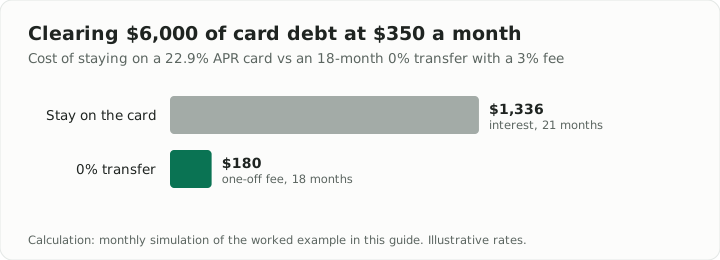
| Stay on current card | 0% transfer for 18 months, 3% fee | |
|---|---|---|
| Upfront cost | $0 | $180 transfer fee |
| Interest paid | $1,336 | $0 |
| Months to pay off | 21 | 18 |
| Total cost of borrowing | $1,336 | $180 |
The transfer saves about $1,150 and clears the debt three months sooner. To finish within the promo period, divide the new balance by the number of months: $6,180 ÷ 18 = about $344 a month.
What happens if you pay less
Now suppose you can only pay $200 a month. On the original card, the debt takes 45 months and costs $2,991 in interest. With the transfer, $3,600 is paid off during the 0% period, but about $2,580 is left when the standard APR (22.9% in this example) kicks in. You still finish sooner, in 33 months, and pay about $410 in interest plus the $180 fee, but the deal is far less clean. The lesson: plan to clear the balance before the promo ends.
When a balance transfer makes sense
- You have a good or excellent credit score, which most 0% offers require. See what moves your credit score.
- You can afford a monthly payment that clears most or all of the balance in the promo period.
- You will stop using the old card for new spending while you pay down the debt.
- Your current interest rate is high enough that the fee is clearly smaller than the interest you avoid.
A quick break-even check: a 3% fee equals roughly two months of interest at 18% APR. If you will need more than a couple of months to pay off the balance, the transfer usually wins.
Traps to avoid
| Trap | Why it hurts | What to do |
|---|---|---|
| Promo ends with a balance left | Standard APRs are often 20%+ | Set a payment that clears it in time |
| New purchases on the transfer card | Purchases may not get 0%, and the minimum payment usually goes to the lowest-rate balance first | Keep the card only for the transferred debt |
| Missing a payment | Some issuers can cancel the promo rate | Set up autopay for at least the minimum |
| Deferred interest offers | Store cards may charge all the back interest if not fully paid | Read the terms; true 0% APR cards do not do this |
| Transferring between cards of the same bank | Most issuers do not allow it | Choose a card from a different issuer |
Tip: Put the promo end date in your calendar with a reminder two months before. That gives you time to make a final push or plan a second move.
Effect on your credit score
Applying for a new card triggers a hard inquiry, which usually lowers your score by a few points for a short time. Opening the card also increases your total available credit. As you pay the balance down, your credit utilisation falls, which is one of the biggest factors in your score. For most people, the score is higher a few months after a well-managed transfer than before it.
Balance transfer vs consolidation loan
| Balance transfer card | Debt consolidation loan | |
|---|---|---|
| Rate | 0% for 12–21 months, then high | Fixed rate, often 8–20% |
| Fees | 3–5% transfer fee | Origination fee of 0–8% on some loans |
| Payment | Flexible minimum | Fixed monthly payment |
| Best for | Debt you can clear within the promo period | Larger debts that need 2–5 years |
If your debt is too big to pay off in the promo period, a debt consolidation loan may be the steadier option. If you have several debts, combine either one with a clear avalanche or snowball plan.
The bottom line
A balance transfer is one of the cheapest ways to pay off credit card debt, as long as you can clear most of the balance before the 0% period ends and you stop adding new spending. Do the maths with the fee included, set up autopay and treat the promo end date as your deadline.
This guide is general information, not financial advice. Offers, fees and approval criteria vary by issuer and country; always read the card’s terms before applying.
More on Credit & Loans
Debt avalanche vs debt snowball: which payoff method saves more?
A worked example with four real-world debts shows how much each method costs, how long it takes and how to pick the one you will actually stick with.
How to compare loan offers: APR, term and the true cost
A lower monthly payment can cost thousands more. How to read a loan offer, spot fee traps and pick the cheapest option.
How to raise your credit score: what works in 30, 60 and 90 days
The five factors behind your score, which ones you can move this month, and a 90-day plan that avoids common myths.
Is a debt consolidation loan worth it? How to run the numbers
How a consolidation loan replaces several high-rate debts with one fixed payment, a worked example with fees included, and when it is the wrong move.