How a 401(k) employer match works (and how much you lose by skipping it)
Match formulas explained, a worked example on a $60,000 salary, vesting rules and the mistakes that leave free money on the table.
Some links are affiliate links: we may earn a commission at no cost to you. How we make money.
An employer match is money your employer adds to your retirement account when you contribute. It is part of your pay, and it is one of the few places in personal finance where you get an instant, guaranteed return. Yet many workers do not contribute enough to receive the full match. This guide explains how matches work and shows what that missed money is worth over a career.
Common match formulas
Employers describe the match as a percentage of your contribution, up to a limit based on your salary.
| Formula | What it means | Employee contributes | Employer adds |
|---|---|---|---|
| 100% up to 3% | Dollar for dollar on the first 3% of pay | 3% | 3% |
| 50% up to 6% | 50 cents per dollar on the first 6% of pay | 6% | 3% |
| 100% of first 3%, 50% of next 2% | Common “safe harbor” formula | 5% | 4% |
The key number is the contribution you need to receive the full match. Below that level, you are leaving money unclaimed.
A worked example: $60,000 salary, 50% up to 6%
| Your contribution | You put in per year | Employer adds per year | Instant return on your money |
|---|---|---|---|
| 0% | $0 | $0 | – |
| 3% | $1,800 | $900 | 50% |
| 6% | $3,600 | $1,800 | 50% |
| 10% | $6,000 | $1,800 | 30% on the total |
Contributing 3% instead of 6% means missing $900 a year. That sounds small, but invested monthly at 7% for 30 years, the difference grows large:
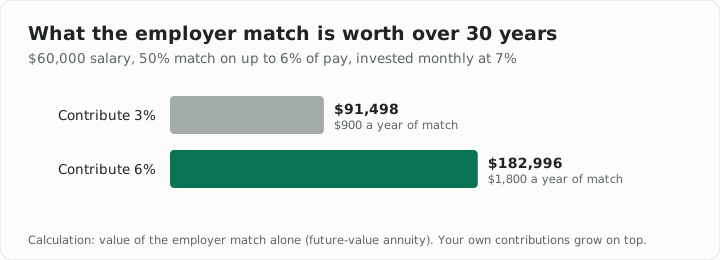
| Match per year | Match alone after 30 years at 7% | |
|---|---|---|
| Contribute 3% | $900 | about $91,500 |
| Contribute 6% | $1,800 | about $183,000 |
That is roughly $91,500 of extra retirement money from the employer, for contributing an extra $150 a month. Your own contributions grow on top of this.
The real cost to your take-home pay is lower than $150 a month, because traditional 401(k) contributions reduce your taxable income. At a 22% tax rate, an extra $150 contribution reduces take-home pay by about $117.
Tip: If 6% feels too much right now, raise your contribution by 1% each year, ideally when you get a pay rise. Many plans offer an automatic increase feature that does this for you.
Vesting: when the match becomes yours
Your own contributions are always 100% yours. The employer’s match may vest over time, which means you have to stay a certain period to keep it.
| Vesting type | How it works | Example |
|---|---|---|
| Immediate | Match is yours straight away | 100% from day one |
| Cliff | 0% until a set date, then 100% | 100% after 3 years |
| Graded | A percentage each year | 20% per year over 2–6 years |
If you are thinking of changing jobs, check your vesting schedule. Leaving a few weeks before a vesting date can cost thousands.
Mistakes that cost people the match
- Not enrolling. Some employers auto-enrol at a low rate, below the full match.
- Hitting the annual limit too early. If you contribute a high percentage and reach the IRS limit early in the year, some plans stop matching for the rest of the year. Ask whether your plan has a “true-up”.
- Leaving contributions in cash. Check that money is invested, for example in a target-date or broad index fund.
- Cashing out when changing jobs. Withdrawals can trigger tax and a 10% penalty. Roll the balance into your new plan or an IRA instead.
- Ignoring fees. High plan fees reduce your return; choose the lowest-cost funds available.
Match first, then what?
A common order for retirement saving in the US:
- Contribute enough to get the full employer match.
- Pay off high-interest debt such as credit cards (see avalanche vs snowball).
- Build an emergency fund.
- Contribute to an IRA or more to your 401(k), choosing Roth or traditional based on your tax rate.
- Increase contributions toward 15% of income over time.
Our compound interest calculator lets you test how different contribution rates grow.
Employer contributions outside the US
The idea of “free money from your employer” exists in most countries, but the rules differ:
| Country | How employer money works | What to do |
|---|---|---|
| United Kingdom | Auto-enrolment workplace pensions require at least 8% of qualifying earnings in total, with at least 3% from the employer. Many employers match more if you pay more | Check whether your employer offers a higher match or salary sacrifice, and contribute enough to get the maximum |
| Canada | Many employers offer a group RRSP or a deferred profit sharing plan (DPSP) that matches a share of your contributions | Contribute at least enough to get the full match, then use your TFSA or RRSP room |
| Australia | Employers must pay the Superannuation Guarantee, 12% of ordinary earnings from 1 July 2025, whether or not you contribute | Check that super is being paid, choose a low-fee fund and consider extra concessional contributions within the cap |
Whatever the country, the principle is the same: never leave employer contributions unclaimed, and keep fees low on the fund the money goes into.
The bottom line
Contribute at least enough to get the full employer match. It is an immediate return of 50% to 100% on your contribution, and over a career it can be worth tens of thousands of dollars or more. Check your vesting schedule, invest the money in low-cost funds and raise your rate a little every year.
This guide is general information, not financial or tax advice. Plan rules vary; read your plan’s summary plan description or ask HR for details.
Compound interest
More on Investing
How much to invest per month to reach $1 million
The exact monthly amount for 20 to 40 years at 5%, 7% and 10% returns, and the three levers that change it most.
How to start investing in index funds: a step-by-step guide
What index funds are, how to pick one, which account to use and why fees matter more than almost anything else.
Robo-advisor vs DIY investing vs a financial advisor: what you really pay
What each option does, how fees compound over 30 years in a worked example, and how to choose the right level of help for your situation.
Roth vs traditional retirement accounts: which one should you choose?
Pay tax now or later? A worked example shows when a Roth beats a traditional IRA or 401(k), plus the rules that tip the decision either way.