Roth vs traditional retirement accounts: which one should you choose?
Pay tax now or later? A worked example shows when a Roth beats a traditional IRA or 401(k), plus the rules that tip the decision either way.
Some links are affiliate links: we may earn a commission at no cost to you. How we make money.
Retirement accounts in the US come in two tax flavours. With a traditional IRA or 401(k), you get a tax break now and pay tax when you withdraw in retirement. With a Roth, you pay tax now and withdrawals in retirement are tax-free. Both let your investments grow without yearly tax. The right choice depends mostly on one question: is your tax rate higher now, or will it be higher in retirement?
Other countries have similar pairs, such as a UK pension versus an ISA or a Canadian RRSP versus a TFSA. The logic in this guide applies to them too.
The key difference
| Traditional | Roth | |
|---|---|---|
| Contributions | Pre-tax or tax-deductible | After tax |
| Growth | Tax-deferred | Tax-free |
| Withdrawals in retirement | Taxed as income | Tax-free (if rules are met) |
| Required minimum distributions | Yes, from a set age | None for Roth IRAs or Roth 401(k)s during the owner’s lifetime |
| Benefit is biggest when | Your tax rate is lower in retirement | Your tax rate is higher in retirement |
A worked example: $5,000 of pre-tax pay
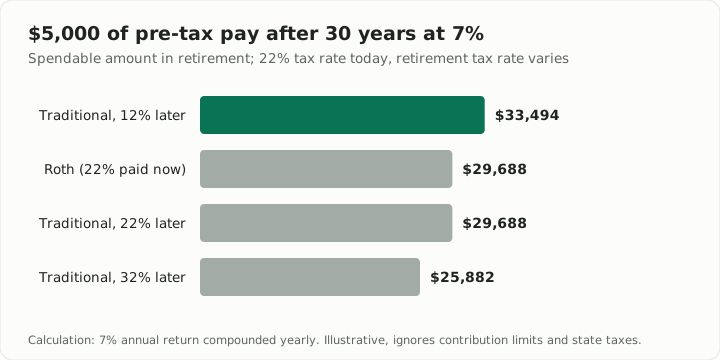
Say you have $5,000 of salary to put towards retirement, your tax rate today is 22% and the money grows at 7% a year for 30 years (it multiplies about 7.6 times).
- Traditional: all $5,000 is invested and grows to about $38,061. You pay tax on withdrawal.
- Roth: you pay $1,100 tax first, so $3,900 is invested. It grows to about $29,688, all tax-free.
| Tax rate in retirement | Traditional (after tax) | Roth | Better choice |
|---|---|---|---|
| 12% | $33,494 | $29,688 | Traditional |
| 22% (same as now) | $29,688 | $29,688 | Tie |
| 32% | $25,882 | $29,688 | Roth |
When the tax rate is the same now and later, the two give exactly the same result. Everything comes down to comparing your rate today with your expected rate in retirement.
Tip: The comparison only holds if you invest the traditional account’s tax saving. If the tax refund gets spent, a Roth often ends up ahead, because it forces you to save the “after-tax” amount.
When a Roth tends to win
- You are early in your career and in a low tax bracket today.
- You expect a higher income later, or you expect tax rates to rise.
- You want flexibility. Roth IRA contributions (not earnings) can generally be withdrawn at any time without tax or penalty.
- You want no required withdrawals. Roth accounts let money keep growing longer.
- You are already saving a lot in pre-tax accounts and want some tax diversification.
When a traditional account tends to win
- You are in your peak earning years and in a high bracket now.
- You expect lower income in retirement, which is true for many people.
- You need the tax saving now to afford to contribute at all.
- You may qualify for income-based benefits or credits that depend on your taxable income today.
2026 contribution limits
| Account | 2026 limit | Catch-up (age 50+) |
|---|---|---|
| 401(k), 403(b), most 457 plans | $24,500 | $8,000 |
| IRA (traditional and Roth combined) | $7,500 | $1,100 |
Limits are set by the IRS and change most years, so check the current figures. Roth IRA contributions are also limited by income; above a certain modified adjusted gross income, you cannot contribute directly. Many workplace plans now offer a Roth 401(k) option, which has no income limit.
You do not have to choose only one
Because nobody knows future tax rates, splitting contributions is a sensible default. Common approaches:
- Capture the employer match first, whatever type it goes into. See how a 401(k) match works.
- Lean Roth when your income is low, and lean traditional as your income rises.
- Aim for a mix so that in retirement you can draw from taxable and tax-free accounts and manage your tax bracket each year.
What to invest in inside the account
The account type is only the wrapper. What you hold inside it matters just as much. For most people, low-cost broad index funds or a target-date fund are a simple choice. Keep fees low: a 1% fee difference can cost more than the whole Roth-versus-traditional decision. Our compound interest calculator shows how contributions grow over time.
Common mistakes
- Leaving money in cash inside the account instead of investing it.
- Withdrawing early. Early withdrawals of earnings can trigger tax plus a 10% penalty, with some exceptions.
- Forgetting the five-year rule. Roth earnings are tax-free only once the account has been open at least five years and you meet the age or other conditions.
- Over-thinking it. Contributing to either account beats waiting for the perfect choice.
Outside the US: the same choice in the UK, Canada and Australia
Most countries offer a “tax relief now” account and a “tax-free later” account. The same rule applies: compare your tax rate today with your expected rate in retirement.
| Country | Tax relief now, taxed later (like traditional) | Taxed now, tax-free later (like Roth) |
|---|---|---|
| United Kingdom | Workplace pension or SIPP: contributions get tax relief at your marginal rate; withdrawals are taxed as income, except a 25% tax-free portion within limits | Stocks and Shares ISA: £20,000 a year, no tax on growth or withdrawals. Lifetime ISA (open aged 18–39): up to £4,000 a year with a 25% government bonus, for a first home or from age 60 |
| Canada | RRSP: deductible contributions up to 18% of the previous year’s earned income (to an annual maximum); withdrawals taxed as income | TFSA: contributions are not deductible; growth and withdrawals are tax-free, and unused room carries forward |
| Australia | Superannuation: concessional contributions are taxed at 15% in the fund (up to an annual cap), and withdrawals are generally tax-free from age 60 once you retire | No direct Roth equivalent; investing outside super uses after-tax money and growth is taxed |
In the UK, employer pension contributions often make the pension the better first choice, much like a 401(k) match. In Canada, a common rule of thumb is TFSA first on a lower income and RRSP first on a higher income. Limits change most years; check HMRC, the Canada Revenue Agency or the Australian Taxation Office for current figures.
The bottom line
Choose traditional if your tax rate is likely to be lower in retirement; choose Roth if it is likely to be higher or you are early in your career. If you are unsure, split your contributions. The habit of contributing every month, into low-cost investments, matters more than the label on the account.
This guide is general information, not tax or financial advice. Tax rules are complex and change; check IRS guidance or speak to a qualified tax professional about your situation.
Compound interest
More on Investing
How a 401(k) employer match works (and how much you lose by skipping it)
Match formulas explained, a worked example on a $60,000 salary, vesting rules and the mistakes that leave free money on the table.
How much to invest per month to reach $1 million
The exact monthly amount for 20 to 40 years at 5%, 7% and 10% returns, and the three levers that change it most.
How to start investing in index funds: a step-by-step guide
What index funds are, how to pick one, which account to use and why fees matter more than almost anything else.
Robo-advisor vs DIY investing vs a financial advisor: what you really pay
What each option does, how fees compound over 30 years in a worked example, and how to choose the right level of help for your situation.