How much to invest per month to reach $1 million
The exact monthly amount for 20 to 40 years at 5%, 7% and 10% returns, and the three levers that change it most.
Some links are affiliate links: we may earn a commission at no cost to you. How we make money.
Reaching $1 million by investing is less about picking winners and more about three numbers: how much you put in each month, how many years you leave it, and the return you earn after fees. This guide shows the exact monthly amount for common timelines, then explains which of those numbers you can actually control.
All figures below assume you start from zero, invest at the end of each month and earn a steady annual return compounded monthly. Real markets do not move in straight lines, so treat these as planning numbers, not promises.
The monthly amount you need
| Years invested | At 5% a year | At 7% a year | At 10% a year |
|---|---|---|---|
| 20 | $2,433 | $1,920 | $1,317 |
| 25 | $1,679 | $1,234 | $754 |
| 30 | $1,202 | $820 | $442 |
| 35 | $880 | $555 | $263 |
| 40 | $655 | $381 | $158 |
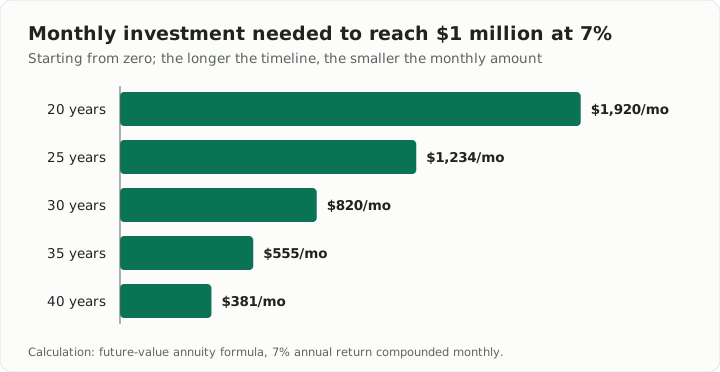
Read across a row and the effect of return is obvious. Read down a column and the effect of time is even larger: at 7%, giving yourself 40 years instead of 20 cuts the monthly amount from $1,920 to $381, roughly a fifth.
Why time beats almost everything else
Compounding means your returns start earning returns of their own. In early years the effect is small; in later years it does most of the work.
Take $500 a month at 7%:
- After 20 years you have about $260,000.
- After 30 years you have about $610,000, from $180,000 of your own money.
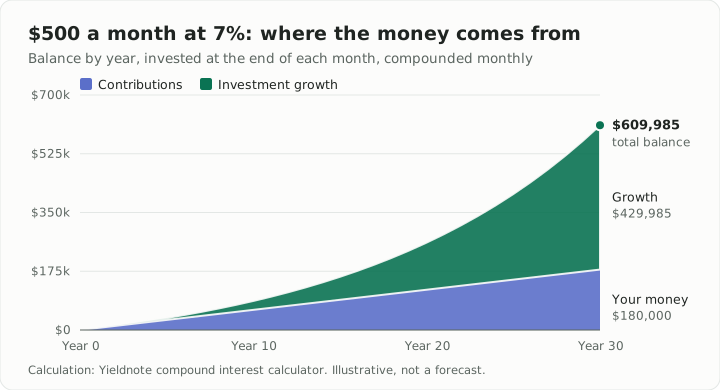
The last ten years added more than the first twenty. That is why starting early matters more than starting big.
A second way to see it: invest $300 a month until age 65 at 7%. Starting at 25 leaves you with about $787,000. Starting at 35 leaves about $366,000. Ten years of delay costs more than half the result, even though the later starter only contributed $36,000 less.
The rule of 72
For quick mental math, divide 72 by your annual return to estimate how many years it takes money to double.
- At 6%, money doubles roughly every 12 years.
- At 8%, roughly every 9 years.
- At 10%, roughly every 7 years.
It is an approximation, but it makes the cost of waiting easy to feel: every doubling period you skip at the start is a doubling you lose at the end.
Which return should you plan with?
The table uses 5%, 7% and 10% because they bracket common planning assumptions:
- 10% is close to the long-run nominal average of the US stock market, before inflation. It is an optimistic planning figure, and individual decades have been far better and far worse.
- 7% is a common way to plan in today’s money, roughly the stock market’s long-run return after inflation.
- 5% suits a more cautious mix that includes bonds, or a plan that wants a safety margin.
If you are not sure, plan with 6–7% and treat anything better as a bonus.
Fees are compounding too, in reverse
A fund that charges 1% a year does not cost you 1% of your money. It costs you 1% every year, compounded.
Using $500 a month for 30 years:
- At a 7% return you end with about $610,000.
- At 6%, the same return minus a 1% fee, you end with about $502,000.
That single percentage point takes over $100,000. Broad index funds from large providers commonly charge a small fraction of that, which is why low-cost index investing is the default recommendation for most long-term savers.
Three levers, in order of impact
- Start date. You can never get back years, so the cheapest improvement is starting now with whatever amount you can, even if it is small.
- Monthly amount. Automate it on payday and raise it whenever your income rises. Increasing contributions by a few percent each year makes a large difference over decades.
- Costs. Choose low-fee, broadly diversified funds and use tax-advantaged accounts where your country offers them. Fees and taxes are the only part of return you control.
Return is not on the list on purpose. You can choose your asset mix, but you cannot choose what markets do.
Try your own numbers
Use the calculator below with your current savings, monthly amount and timeline. Then change one input at a time: start five years later, add $100 a month, or lower the return by one point for fees. Watching the ending balance move is the fastest way to see which lever matters most for you.
A simple plan to get started
- Open a low-cost brokerage or retirement account.
- Choose one broad, diversified index fund, or a target-date fund that rebalances for you.
- Set up an automatic monthly transfer the day after payday.
- Check once or twice a year, not every day.
Tip: If $820 a month feels out of reach, start with what you can. $200 a month at 7% for 40 years grows to roughly $525,000, and every raise you direct into it shortens the road.
This guide is general education, not personal financial advice. Investments can lose value, and past returns do not guarantee future results. Consider your situation or speak with a licensed adviser before investing.
Compound interest
More on Investing
How a 401(k) employer match works (and how much you lose by skipping it)
Match formulas explained, a worked example on a $60,000 salary, vesting rules and the mistakes that leave free money on the table.
How to start investing in index funds: a step-by-step guide
What index funds are, how to pick one, which account to use and why fees matter more than almost anything else.
Robo-advisor vs DIY investing vs a financial advisor: what you really pay
What each option does, how fees compound over 30 years in a worked example, and how to choose the right level of help for your situation.
Roth vs traditional retirement accounts: which one should you choose?
Pay tax now or later? A worked example shows when a Roth beats a traditional IRA or 401(k), plus the rules that tip the decision either way.