How to start investing in index funds: a step-by-step guide
What index funds are, how to pick one, which account to use and why fees matter more than almost anything else.
Some links are affiliate links: we may earn a commission at no cost to you. How we make money.
An index fund buys every company in a market index, such as the S&P 500 or a global stock index, so you own a small slice of the whole market in one purchase. You get the market’s return, minus a small fee, without picking stocks. For most long-term investors, that simple approach is hard to beat.
Why index funds work
- Diversification. One fund can hold hundreds or thousands of companies, so no single failure sinks you.
- Low costs. There is no team of stock pickers to pay, so broad index funds often charge a small fraction of a percent per year.
- Consistency. Over long periods, most actively managed funds have trailed their benchmark index after fees, according to long-running comparisons such as S&P’s SPIVA reports.
- Simplicity. Fewer decisions means fewer mistakes, like selling in a panic or chasing last year’s winner.
Fees: the number that compounds against you
The fee, called the expense ratio, is charged every year on your whole balance. Small differences become large over decades.
Investing $300 a month for 30 years at a 7% market return, the ending balance depends heavily on the fee:
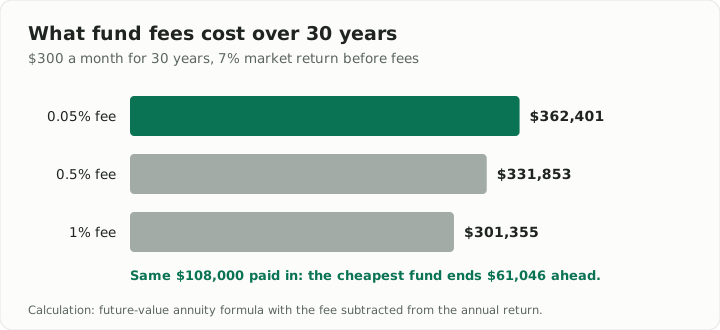
Moving from a 1% fund to a 0.05% fund leaves you roughly $61,000 richer on the same contributions.
Step 1: Choose the right account
Where you invest matters as much as what you buy:
- Retirement accounts with tax benefits come first if your country offers them, such as a 401(k) or IRA in the US, an ISA or SIPP in the UK, or a superannuation fund in Australia. Take any employer match: it is an instant return on your money.
- A regular brokerage account works for goals that are not retirement, with no tax shelter but full flexibility.
Step 2: Pick one broad fund
You do not need many funds. A sensible core is one of:
- A total world stock index fund, which spreads money across many countries.
- A total market or S&P 500 fund for a home-market core, if that suits your situation.
- A target-date fund, which mixes stocks and bonds and becomes more conservative as your retirement year approaches. It handles rebalancing for you.
Check the expense ratio, the index it tracks and how closely it has matched that index.
Step 3: Decide how much risk to take
Stocks grow faster over long periods but can fall 30% or more in a bad year. Bonds are steadier but grow more slowly. A common way to set the mix:
- Money needed in less than five years should not be in stocks.
- For long-term money, hold a mix you could stick with through a sharp fall without selling.
- Many investors become more conservative as their goal approaches.
Step 4: Automate it
Set up a fixed monthly contribution on payday. Investing the same amount every month, called dollar-cost averaging, means you buy more shares when prices are low and fewer when they are high, and you never have to decide when to invest.
Step 5: Leave it alone
Check once or twice a year. If your stock and bond mix has drifted far from your plan, rebalance by directing new money to the part that fell behind. Avoid selling during downturns: the biggest long-term returns often arrive shortly after the worst days.
Common mistakes
- Buying too many overlapping funds that hold the same companies.
- Chasing performance by switching to last year’s best fund.
- Ignoring fees because they look small.
- Stopping contributions when markets fall, which is when shares are cheapest.
See your numbers
Use the calculator below with your monthly amount and timeline. Then lower the return by your fund’s fee to see its true long-term cost.
Tip: Increase your contribution by 1% of your income each time you get a raise. You will barely notice the difference in your paycheck, but your future balance will.
This guide is general education, not financial advice. Investments can lose value, and past performance does not guarantee future results.
Compound interest
More on Investing
How a 401(k) employer match works (and how much you lose by skipping it)
Match formulas explained, a worked example on a $60,000 salary, vesting rules and the mistakes that leave free money on the table.
How much to invest per month to reach $1 million
The exact monthly amount for 20 to 40 years at 5%, 7% and 10% returns, and the three levers that change it most.
Robo-advisor vs DIY investing vs a financial advisor: what you really pay
What each option does, how fees compound over 30 years in a worked example, and how to choose the right level of help for your situation.
Roth vs traditional retirement accounts: which one should you choose?
Pay tax now or later? A worked example shows when a Roth beats a traditional IRA or 401(k), plus the rules that tip the decision either way.