Robo-advisor vs DIY investing vs a financial advisor: what you really pay
What each option does, how fees compound over 30 years in a worked example, and how to choose the right level of help for your situation.
Some links are affiliate links: we may earn a commission at no cost to you. How we make money.
There are three main ways to manage long-term investments: do it yourself with low-cost index funds, use a robo-advisor that does it automatically, or pay a human financial advisor. All three can work. The biggest differences are how much you pay, how much effort you put in and how much personal advice you get. Fees look small as percentages, but over decades they add up to a large share of your money.
The three options at a glance
| DIY index investing | Robo-advisor | Human financial advisor | |
|---|---|---|---|
| What you do | Choose funds, invest, rebalance | Answer a questionnaire, add money | Meet, agree a plan, add money |
| Typical total yearly cost | 0.03%–0.20% (fund fees) | 0.25%–0.50% (platform plus fund fees) | 1%–1.5% or more (advisory plus fund fees) |
| Rebalancing | Manual | Automatic | Done for you |
| Tax-loss harvesting | Manual, if at all | Often automatic in taxable accounts | Depends on the advisor |
| Personal planning | None | Limited; some offer advisor access for a fee | Full: retirement, tax, estate, insurance |
| Best for | Confident, hands-off investors | People who want automation | Complex finances or big life decisions |
How fees add up: a worked example
You invest $500 a month for 30 years (a total of $180,000) and the portfolio earns 7% a year before fees. The only difference is the total yearly cost.
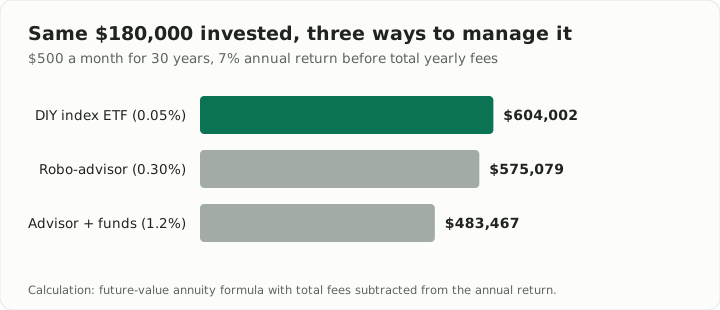
| Approach | Total yearly cost | Value after 30 years | Cost vs DIY |
|---|---|---|---|
| DIY index ETFs | 0.05% | $604,002 | – |
| Robo-advisor | 0.30% | $575,079 | $28,923 |
| Advisor + funds | 1.20% | $483,467 | $120,535 |
A 1.2% total cost reduces the final balance by about 20% compared with DIY in this example. That does not mean an advisor is never worth it. It means the advice needs to be worth that much to you, for example by preventing costly mistakes or saving tax.
Tip: Ask any advisor for their total yearly cost in dollars, including fund fees, not just the advisory percentage. Then multiply it by 30 years to see what you are really agreeing to.
DIY investing: cheapest, if you stick with it
DIY means opening a brokerage account and buying a small number of broad, low-cost funds. A one-fund option such as a target-date fund, or a simple two- or three-fund mix of global stocks and bonds, is enough for most people. Our index fund starter guide walks through the setup.
Pros: lowest cost, full control, simple once set up. Cons: you must rebalance and, most importantly, avoid selling in a panic when markets fall.
Robo-advisors: automation for a small fee
A robo-advisor asks about your goals and risk tolerance, then builds and manages a diversified portfolio of index funds. It invests new deposits, rebalances and, in many cases, uses tax-loss harvesting in taxable accounts.
Pros: fully automatic, low minimums, removes many behavioural mistakes. Cons: costs more than DIY, limited personalisation, little help with wider planning.
A robo-advisor makes sense if you know you would not rebalance yourself, or if automation keeps you investing consistently.
Human advisors: for complex situations
A good advisor helps with much more than picking funds: retirement income planning, tax strategy, insurance, estate planning and coaching you through market crashes. This can be valuable for business owners, people with equity compensation, inheritances, or anyone near retirement.
How they are paid matters:
| Payment model | How it works | Watch out for |
|---|---|---|
| Percentage of assets (AUM) | Typically around 1% a year | Cost grows as your balance grows |
| Flat or hourly fee | Fixed price for a plan or a session | Less ongoing support unless you pay again |
| Commission | Paid by product providers | Conflict of interest in recommending products |
Look for a fiduciary, who is legally required to act in your best interest, and prefer fee-only advisors who do not earn commissions.
How to choose
- Simple finances, comfortable with basics: DIY index funds.
- Want it automated and are happy to pay a little: robo-advisor.
- Complex situation or a big decision coming up: a fee-only fiduciary, possibly on a one-off or hourly basis while you keep running a DIY or robo portfolio.
A hybrid approach often gives the best value: pay for a one-time financial plan, then run the portfolio cheaply yourself or through a robo-advisor.
Mistakes to avoid
- Paying high fees for a portfolio of the same index funds you could buy yourself.
- Switching between providers based on short-term performance.
- Holding expensive actively managed funds inside a robo or advisor account.
- Forgetting that the account type also matters: use tax-advantaged accounts such as a Roth or traditional IRA and any employer match first.
Use our compound interest calculator to test how different fee levels change your result.
Outside the US
Robo-advisors and low-cost platforms operate in many countries, and the same fee maths applies. A few local points:
- United Kingdom: most robo-advisors offer ISAs and SIPPs; compare the total of the platform fee and the fund fees, and check that the provider is authorised by the FCA.
- Canada: robo-advisors commonly offer TFSA and RRSP accounts; all-in-one ETFs are a cheap DIY alternative.
- Australia: micro-investing apps and robo-advisors are popular, but low balances can make flat monthly fees expensive as a percentage. For retirement, compare your super fund’s indexed options first.
- European Union: check that the service is authorised in your country and that it uses UCITS funds; fees and tax reporting vary widely by country.
Whatever the country, a fee-only adviser who is regulated locally is the safest choice when you need personal advice.
The bottom line
Fees compound just like returns. DIY index investing is the cheapest; robo-advisors cost a little more but automate everything; human advisors cost the most and earn their fee only when they add real planning value. Choose the least expensive option that you will actually stick with through good and bad markets.
This guide is general information, not financial advice. Past returns do not guarantee future returns, and the 7% figure is illustrative.
Compound interest
More on Investing
How a 401(k) employer match works (and how much you lose by skipping it)
Match formulas explained, a worked example on a $60,000 salary, vesting rules and the mistakes that leave free money on the table.
How much to invest per month to reach $1 million
The exact monthly amount for 20 to 40 years at 5%, 7% and 10% returns, and the three levers that change it most.
How to start investing in index funds: a step-by-step guide
What index funds are, how to pick one, which account to use and why fees matter more than almost anything else.
Roth vs traditional retirement accounts: which one should you choose?
Pay tax now or later? A worked example shows when a Roth beats a traditional IRA or 401(k), plus the rules that tip the decision either way.