How much life insurance do you need? A step-by-step calculation
Work out your coverage in four steps with the DIME method, choose a term length, and avoid the most common mistakes.
Some links are affiliate links: we may earn a commission at no cost to you. How we make money.
Life insurance replaces the money your family would lose if you died. Too little cover leaves them with debts and a gap in income; too much means paying premiums for protection nobody needs. This guide walks through a calculation you can finish in fifteen minutes, then helps you choose between term and whole life.
Do you need life insurance at all?
You probably need it if someone depends on your income or would inherit a debt you leave behind. That usually means:
- You have children or other dependants.
- A partner relies on your income to cover housing or living costs.
- You co-signed a loan or have a mortgage someone else would have to pay.
- You own a business with partners who depend on you.
You probably do not need it if you are single with no dependants and no shared debts, or if your savings already cover everything your family would need.
Step 1: Add up what your family would need (the DIME method)
DIME stands for Debt, Income, Mortgage and Education, the four costs life insurance usually has to cover.
- Debt. Total your non-mortgage debts: car loans, credit cards, personal loans, plus an allowance for final expenses.
- Income. Multiply your annual take-home pay by the number of years your family would need support. A common choice is until your youngest child finishes education.
- Mortgage. The remaining balance on your home loan, or several years of rent if you rent.
- Education. A realistic estimate of future school or university costs for each child.
Add the four together.
Step 2: Subtract what you already have
From that total, subtract resources your family could use immediately:
- Savings and investments you would leave behind.
- Existing life cover, including any policy through your employer.
- Survivor benefits from a pension or social security system, if they apply in your country.
The result is your coverage gap, the amount to insure.
Step 3: Sanity-check with the income multiple
A quick cross-check many planners use is 10 to 12 times your annual income. If your DIME result is far above or below that range, review your inputs. Large mortgages or several young children push the number up; substantial savings push it down.
A worked example
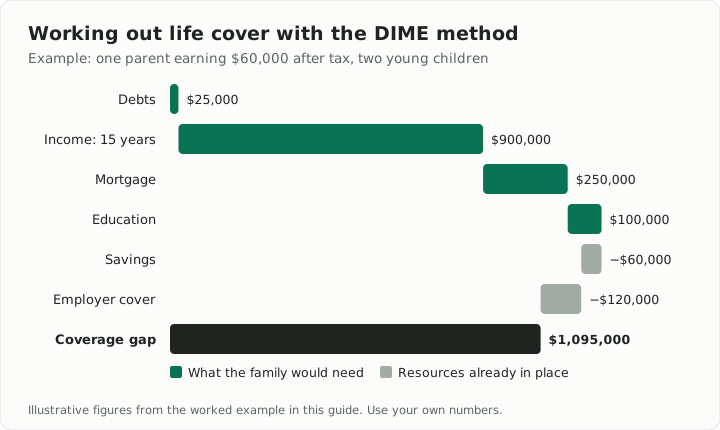
Consider a household where one parent earns $60,000 a year after tax and supports two young children:
| Item | Amount |
|---|---|
| Debts (car loan, cards, final expenses) | $25,000 |
| Income: $60,000 × 15 years | $900,000 |
| Mortgage balance | $250,000 |
| Education for two children | $100,000 |
| Total need | $1,275,000 |
| Minus savings | −$60,000 |
| Minus employer cover | −$120,000 |
| Coverage gap | $1,095,000 |
That lands close to 18 times income, higher than the rule of thumb because of the long support period and the mortgage. Rounding to a $1 million policy would be reasonable. These figures are illustrative; use your own.
Step 4: Choose how long the cover should last
Term life covers a fixed period, usually 10, 15, 20 or 30 years. Choose the term that ends when your largest obligations end:
- When your youngest child becomes financially independent.
- When the mortgage is paid off.
- When your retirement savings could support your partner on their own.
Some people ladder policies, for example one 30-year policy and one 15-year policy. The total cover is highest while children are young and the mortgage is large, then steps down, which usually costs less than one large 30-year policy.
Term or whole life?
| Term life | Whole life | |
|---|---|---|
| How long it lasts | A fixed period | Your whole life |
| Cost for the same payout | Much lower | Many times higher |
| Cash value | None | Builds slowly, with fees |
| Best for | Replacing income during working and parenting years | Lifelong needs and estate planning |
For most families, term life does the job at a fraction of the price. Whole life can make sense for permanent needs, such as supporting a dependant who will never be financially independent, or for estate planning in high-net-worth households. If someone recommends whole life, ask for advice from a fee-only planner who does not earn commission on the policy.
What changes your premium
Insurers price term life mainly on:
- Age. Premiums rise each year you wait, so buying earlier locks in a lower rate.
- Health. Medical history, height and weight, and test results.
- Smoking. Smokers typically pay far more than non-smokers.
- Term and amount. Longer terms and larger payouts cost more.
- Occupation and hobbies. Dangerous jobs or activities can raise the price.
Prices for identical cover vary between insurers, so comparing several quotes is the simplest way to save.
Common mistakes
- Relying only on employer cover. It is often one to two times salary and usually ends when you leave the job.
- Forgetting a stay-at-home partner. Replacing childcare and household work costs real money.
- Leaving beneficiaries out of date. Review them after marriage, divorce or a new child.
- Hiding health details. Inaccurate applications can give the insurer grounds to refuse a claim.
Tip: Recalculate every few years or after major life events. Paying off the mortgage or children leaving home can mean you need far less cover than before.
This guide is general information, not insurance or financial advice. Products, rules and tax treatment differ by country; read policy terms carefully and consider a licensed adviser.
More on Insurance
High-deductible health plan vs PPO: which costs less?
How deductibles, coinsurance and out-of-pocket maximums work, a worked comparison across light, average and heavy medical years, and how an HSA changes the maths.
How much home insurance do you need? Coverage limits explained
Why you insure the rebuild cost, not the market price, how to set each coverage limit, how to pick a deductible and the gaps most policies leave.
How to lower your car insurance: 10 ways that actually work
Shopping around, the right deductible and the discounts insurers rarely mention. What saves money, and what quietly costs you more.