High-deductible health plan vs PPO: which costs less?
How deductibles, coinsurance and out-of-pocket maximums work, a worked comparison across light, average and heavy medical years, and how an HSA changes the maths.
Some links are affiliate links: we may earn a commission at no cost to you. How we make money.
Choosing a health plan during open enrolment often comes down to one trade-off: pay more every month for a plan with a low deductible, or pay less each month and take on more cost if you get sick. The cheapest premium is not always the cheapest plan, and the plan with the lowest deductible is not always the safest. This guide explains the terms and compares total yearly costs across three scenarios.
This guide uses US health insurance terms. The same logic (fixed premium versus cost when you use care) applies to many private health plans elsewhere.
The four numbers that decide your cost
| Term | What it means |
|---|---|
| Premium | What you pay every month to have the plan, whether you use it or not |
| Deductible | What you pay for covered care each year before the plan starts sharing costs |
| Coinsurance / copay | Your share after the deductible, such as 20% of a bill or a fixed $30 visit fee |
| Out-of-pocket maximum | The most you pay for covered in-network care in a year (not counting premiums) |
Your true yearly cost is: premiums + what you pay for care (up to the out-of-pocket maximum) − any employer contribution to an HSA.
Note that many plans cover certain preventive care, such as annual check-ups and some screenings, before you meet the deductible.
A worked comparison
Two illustrative employer plans for one person:
| PPO | High-deductible plan (HDHP) | |
|---|---|---|
| Monthly premium | $250 | $130 |
| Premiums per year | $3,000 | $1,560 |
| Deductible | $1,000 | $3,000 |
| Coinsurance after deductible | 20% | 20% |
| Out-of-pocket maximum | $4,000 | $6,000 |
| Employer HSA deposit | None | $750 |
Here is the total yearly cost in three different years:
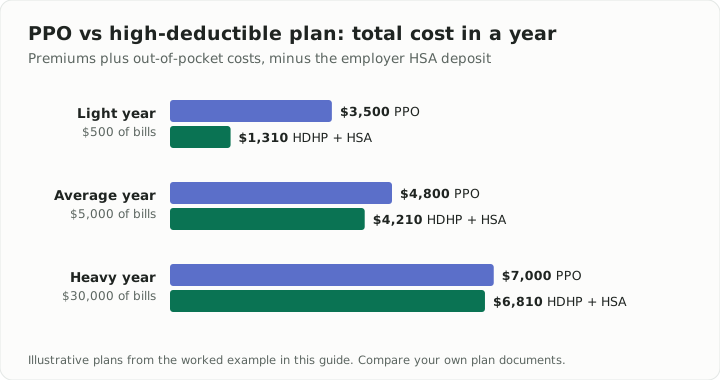
| Scenario | Medical bills | PPO total | HDHP total (after HSA deposit) |
|---|---|---|---|
| Light year | $500 | $3,500 | $1,310 |
| Average year | $5,000 | $4,800 | $4,210 |
| Heavy year | $30,000 | $7,000 | $6,810 |
In this example, the HDHP is cheaper in all three years, because the $1,440 premium saving plus the $750 HSA deposit covers most of its higher deductible and out-of-pocket maximum. Your plans may look very different. The PPO usually wins when its premium is only slightly higher, or when the HDHP’s out-of-pocket maximum is much higher, and you expect high costs.
Tip: Work out your “worst year” for each plan: annual premiums plus the out-of-pocket maximum, minus any employer HSA deposit. If you could not cover the worst year of the cheaper plan from savings, that matters as much as the average.
How an HSA changes the maths
A health savings account (HSA) is available only with an HSA-eligible high-deductible plan. In the US it has unusual tax benefits:
- Contributions are tax-deductible (or pre-tax through payroll).
- Investment growth inside the account is tax-free.
- Withdrawals for qualified medical expenses are tax-free.
For 2026 the IRS contribution limits are $4,400 for self-only coverage and $8,750 for family coverage, with an extra $1,000 catch-up from age 55. Limits change every year, so check the current figures.
The money stays yours if you change jobs, and unused balances roll over every year. If you can afford to pay small medical bills from your regular budget, some people invest the HSA and let it grow as a long-term health fund.
The tax saving makes the HDHP even more attractive. If you contribute $2,000 a year and your combined tax rate is 25%, that saves about $500 in tax, on top of the numbers above.
Which plan suits you?
| Situation | Often the better fit |
|---|---|
| Healthy, few doctor visits, has an emergency fund | HDHP with HSA |
| Ongoing prescriptions or regular specialist visits | Compare carefully; PPO often wins |
| Planned surgery or pregnancy in the coming year | Compare worst-year costs; low out-of-pocket maximum matters |
| Little savings to cover a large deductible | PPO or a lower-deductible plan |
| Wants to see specialists without referrals | PPO (check the network) |
Other things to check
- Network: Are your doctors and nearest hospital in-network? Out-of-network care can cost far more.
- Drug formulary: Are your regular prescriptions covered, and at what tier?
- Family coverage: Family plans have an overall deductible and sometimes a per-person deductible.
- Employer contributions: HSA deposits from your employer are effectively part of your pay.
How to decide in 20 minutes
- Write down last year’s medical spending and anything you expect this year.
- For each plan, calculate premiums plus expected out-of-pocket costs, minus any HSA deposit.
- Calculate each plan’s worst-case year.
- Check networks and prescriptions.
- Choose the plan with the best expected cost whose worst year you can afford, ideally with an emergency fund that covers the deductible.
The bottom line
Compare total yearly cost, not just the premium or the deductible. For healthy people with savings, a high-deductible plan with an HSA is often the cheapest choice, especially when the employer adds money to the HSA. If you expect high medical costs or cannot cover a large deductible, a plan with a higher premium and lower out-of-pocket costs may be the safer pick.
This guide is general information, not insurance, tax or medical advice. Plan details vary widely; read your plan’s summary of benefits and coverage before enrolling.
More on Insurance
How much home insurance do you need? Coverage limits explained
Why you insure the rebuild cost, not the market price, how to set each coverage limit, how to pick a deductible and the gaps most policies leave.
How much life insurance do you need? A step-by-step calculation
Work out your coverage in four steps with the DIME method, choose a term length, and avoid the most common mistakes.
How to lower your car insurance: 10 ways that actually work
Shopping around, the right deductible and the discounts insurers rarely mention. What saves money, and what quietly costs you more.