How blogs make money: a realistic guide for beginners
The six ways content sites earn, how much traffic each one needs, real startup costs and an honest timeline.
Some links are affiliate links: we may earn a commission at no cost to you. How we make money.
A content site, whether a blog, a niche guide site or a newsletter, earns by turning readers’ attention into revenue. It can become a real asset, but it is slow at first and the income depends far more on topic and audience than on traffic alone. This guide covers how the money actually flows, what it costs to start and how long it usually takes.
The six main income streams
1. Display advertising
Ad networks pay you for showing ads, measured as RPM: revenue per 1,000 pageviews.
- RPM varies several-fold by topic (finance, insurance and software pay far more than entertainment) and by reader country (advertisers pay more to reach readers in high-income markets).
- Google AdSense is the usual starting point. Premium ad management companies pay more but set minimum monthly traffic requirements.
- Ads are easy to add but need large traffic to produce meaningful income on their own.
2. Affiliate marketing
You earn a commission when a reader buys or signs up through your link. Commissions may be a percentage of a sale, a flat fee per signup, or recurring for subscriptions.
- Works best on pages where readers are about to decide: comparisons, reviews, “best X for Y” and how-to guides that need a tool.
- A small, targeted audience can out-earn a large general one, because one sale can be worth more than thousands of ad impressions.
3. Email list
An email list is not income by itself, but it multiplies every other stream. Readers who subscribe come back, click affiliate links and buy products far more often than one-time visitors. You also own the list; search rankings and social reach can change overnight.
4. Digital products
Templates, ebooks, spreadsheets and printables have high margins: build once, sell indefinitely. They work best once you know what your readers repeatedly ask for.
5. Sponsorships
Brands pay a flat fee to reach your audience through a sponsored article, newsletter placement or banner. Sponsors care about audience fit and engagement more than raw size, so a focused newsletter can sell sponsorships early.
6. Services and memberships
Consulting, coaching or a paid membership tier convert your expertise directly. They need trust, which your free content builds.
How the maths works
A simple way to estimate monthly income from a page:
- Ads: pageviews ÷ 1,000 × RPM.
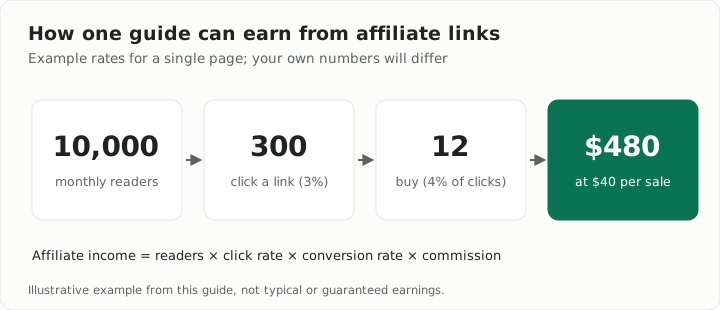
- Affiliate: pageviews × click-through rate × conversion rate × commission.
An illustration with example numbers: a guide with 10,000 monthly views, where 3% of readers click a partner link, 4% of those buy, and each sale pays $40, earns 10,000 × 0.03 × 0.04 × $40 = $480 a month from affiliate income, before any ads. Your own rates will differ; the point is that buying-intent pages and good offers matter more than traffic volume.
What it costs to start
| Item | Typical cost |
|---|---|
| Domain name | Around $10–20 a year |
| Hosting | Free for static sites; a few dollars a month for basic managed hosting |
| Email platform | Free tiers exist for small lists |
| Writing tools | Optional; many have free plans |
| Your time | The real investment: hundreds of hours in year one |
You do not need paid themes, courses or premium tools to start. The cost that matters is consistency.
An honest timeline
- Months 1–3: Publishing, almost no search traffic. New sites take time to earn Google’s trust.
- Months 3–9: Pages start ranking for specific, low-competition questions. First affiliate commissions often appear here.
- Months 9–18: Sites that keep publishing useful content compound: more pages rank, older pages climb, and ad income becomes noticeable.
- After 18 months: Successful sites can earn a steady side or full-time income, and some are sold for a multiple of their monthly profit.
Many sites never get there, usually because the owner stops publishing in the quiet early months, picks a topic with no buying intent, or copies content that already exists.
How to choose a topic
Pick the overlap of three things:
- You can write about it for a year without running out of ideas.
- Readers spend money on related products or services.
- You can answer specific questions better than the current top results, through experience, testing or clearer explanations.
Then go narrower than feels comfortable. “Personal finance” is crowded; “personal finance for freelancers” or “investing for nurses” is a niche you can own.
A 30-day starting plan
- Week 1: Choose the niche, register a domain, set up the site and an email signup.
- Week 2: List 50 specific questions your readers ask. Group them by topic.
- Weeks 3–4: Publish your first 8–10 genuinely helpful answers, each targeting one question.
- Every week after: publish consistently, add one useful offer to each relevant page, and send one email.
Using AI responsibly
AI writing tools speed up outlines, research summaries and editing. Search engines reward helpful, accurate content regardless of how it was produced, but they demote thin pages produced at scale. Use AI to draft, then add what only you can: real experience, original examples, fact-checking and clear opinions.
Tip: Write the pages that make you money first. A handful of strong comparison and how-to guides with good affiliate offers often earn more than dozens of general articles.
Earnings vary widely and are not guaranteed. Disclose affiliate relationships clearly, as many countries require.
Fast WordPress hosting with free SSL and daily backups.
Landing pages, automations and paid newsletters.
Drafts, outlines and rewrites inside your browser.